Let me preface this article by saying that I have always been as anti-NCAA tournament expansion/modification as anyone on the planet. Ever since the concept was first seriously contemplated in 2010, I have been an adamant opponent of any modification to what I still consider the most perfect sporting event on Earth. In fact, I didn’t even like the initial play-in game when it was added in 2003 nor did I approve of the full First Four concept when it began in 2011. I also didn’t like, and still don’t really care for, the “pod system” of selecting NCAA tournament sites when it was devised way back in the summer of 2001. I have always been of the mindset that the tournament is perfect with how it is… don’t mess with it. With that being said, a series of incremental changes throughout the sport have made me re-consider my position, and I now favor a larger NCAA tournament field, AS LONG AS IT IS DONE CORRECTLY (more on that in a minute).
What’s Changed My Mind:
(1) Unfairness for Mid and Low Major Regular Season Conference Champions
The most influential factor in my change of heart regarding NCAA tournament expansion involves my local UNCW Seahawks who I have developed a strong affinity for over the past decade that I have lived in Wilmington. During this time, UNCW has won two CAA tournament championships, and as a result, they have made two NCAA tournament appearances (2017 and 2025). However, on two other occasions, including this past season, the Seahawks won their regular season conference championship but failed to win their conference tournament. This season’s postseason heartbreak was especially cruel as UNCW scratched and crawled their way to a CAA regular season title with a slew of narrow victories that ultimately yielded an impressive 15-3 conference record. Down the stretch of the season, they managed to hold off College of Charleston for first place in the league by winning their regular season finale on the road over Elon, after Charleston won its last five regular season games to pull within a half game of the Seahawks in the standings. Nevertheless, at the end of the day, it didn’t really matter. One bad half of basketball, in a game I attended a little over two weeks ago in Washington DC, killed UNCW’s NCAA tournament hopes, as the 9 seeded Campbell Camels upset 1 seeded UNCW in the CAA tournament quarterfinals. UNCW swept Campbell in two hard fought regular season games, but in the end, those games were rendered meaningless because all that really matters in mid-major leagues are conference tournament games.
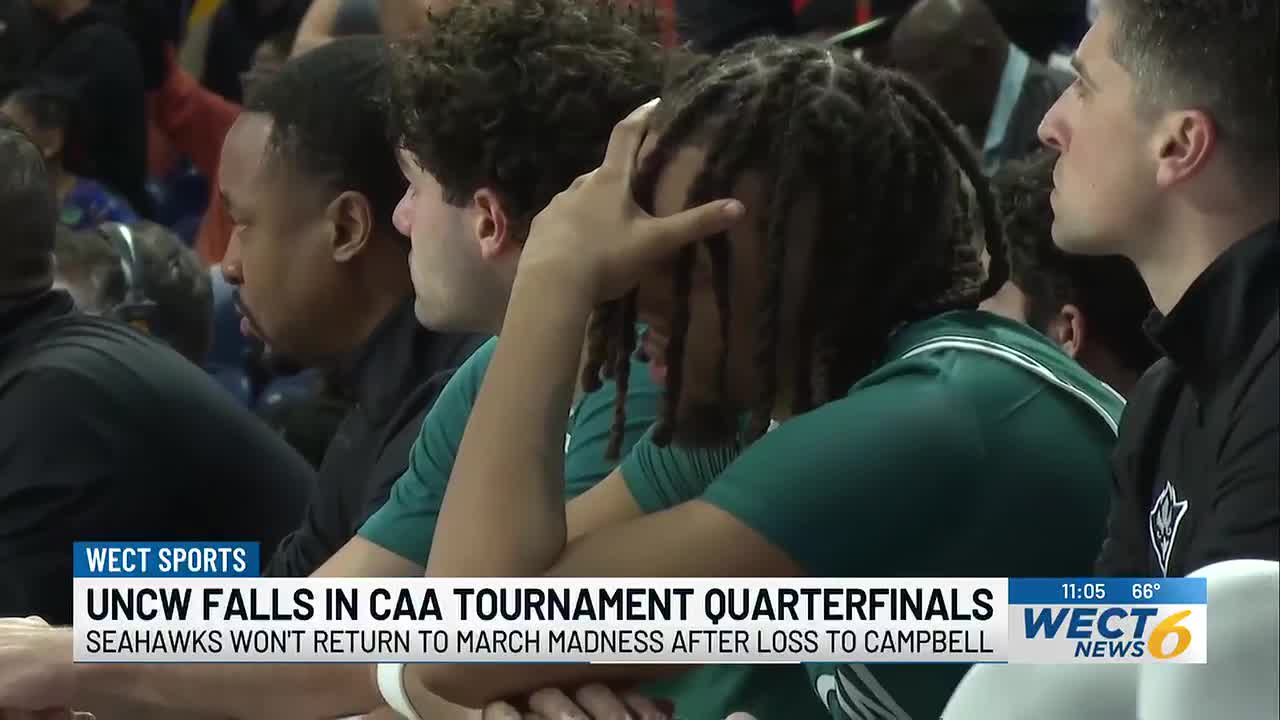
I used this recent anecdotal example to illustrate the concept that it just isn’t fair that the only NCAA tournament bid in these small conferences is awarded to each league’s tournament champion. It completely devalues the regular season, especially since now regular season mid-major conference champions aren’t guaranteed NIT automatic bids like they were in years past (more on that in a minute). Yes, I do realize that these small conference tournaments do make March Madness more exciting for the fans and people who follow the sport, but should excitement always be valued over fundamental fairness? Think if all high school students were only allowed to take the SAT once and college admissions were based entirely on that one SAT score, in lieu of factors such as GPA, class rank, extracurriculars, etc. This would make for a really exciting college admissions process, but it certainly wouldn’t be fair to that 4.0 valedictorian who was sick on his SAT test day and produced a much lower than expected score. That is basically what we have in the NCAA tournament as it stands today- a system that completely ignores 96% of the total body of work of a mid-major team. However, at the same time, I also realize you can’t just kill off mid-major conference tournaments because they are such an integral part of March Madness and the excitement it produces. My plan for expansion, which you will see below, thus allows conference tournaments to maintain their prominence while also awarding regular season league champions by giving each of the 31 conferences two automatic bids, one for its league regular season champion and one for its tournament champion. I have come to realize this is the only way to truly balance the excitement of March with the fairness of rewarding each team’s entire body of work. This would also make regular season games more meaningful across all conferences, but especially in the traditional one bid leagues that would now be given an extra bid for their regular season champions.
(2) Lack of Recent Cinderellas
There is a growing theory amongst sports pundits and talking heads that NIL and the transfer portal have “killed” the NCAA tournament Cinderella, as a team seeded 13 or higher has failed to win a game in the past two tournaments. And while I don’t agree that Cinderella is necessarily dead, she certainly seems to have been injured so to speak. Yes, I realize High Point had a great 12 over 5 victory over Wisconsin this year’s first round and 16 seeded Siena took Duke to the wire as well, but at the end of the day the Oakland Golden Grizzlies were the last team seeded 13 or higher to win an NCAA tournament game when they knocked off Kentucky back in 2024 thanks to Jack Gohlke’s incredible and somewhat flukish 10 of 20 shooting from three point range. This is particularly noteworthy because of the fact THIS THE FIRST TIME EVER A 13 SEED OR LOWER HAS FAILED TO WIN A GAME IN CONSECUTIVE NCAA TOURNAMENTS. You could say that this is just a statistical anomaly that should correct itself next year, and you may be right, but unfortunately there wasn’t even just a lack of upsets by low seeds in the first round of this season’s tournament, there was a lack of competitive first round games in general, as only 6 of the 32 first round matchups were decided by five points or less. In fact, thirteen of these games were 20+ point blowouts won by the team which was favored. So how would expansion remedy this problem you might ask? My plan that you will see below calls for eight different regions seeded 1-16 so there will be twice as many opportunities for mid and low major teams seeded 13 or lower to knock off a top four seed. To put it bluntly, more opportunity will equal more upsets.
Also, as you will see in the bracket below, because there are more teams seeded on each line, each of the seed lines for the top 3/4 of the bracket are relatively weaker than they currently are, which would also bring about more upsets. For instance, all of the current teams seeded 3 and 4 would become two seeds, all of the 5 and 6 seeds would be 3 seeds, and so on and so forth. Therefore, instead of forcing 13 seeded Cal Baptist to play one of the top 15 teams in the tournament in Kansas, they would get a much more winnable 13 vs. 4 matchup against Saint Mary’s, who was ranked 26th by the selection committee, in my proposed bracket below.
(3) Downfall of the NIT
The NIT has been the second fiddle to the NCAA tournament for more than 85 years now, but it still used to carry much greater credibility than it currently does. The format has evolved over time but the NIT previously featured a field of “the next best” 16-32 teams in the the country, most of which were power conference programs, battling it out for a right to play in Madison Square Garden for chance to hang a championship banner In fact, up until a few years ago, Tennessee used to have a banner acknowledging each of its NIT appearances
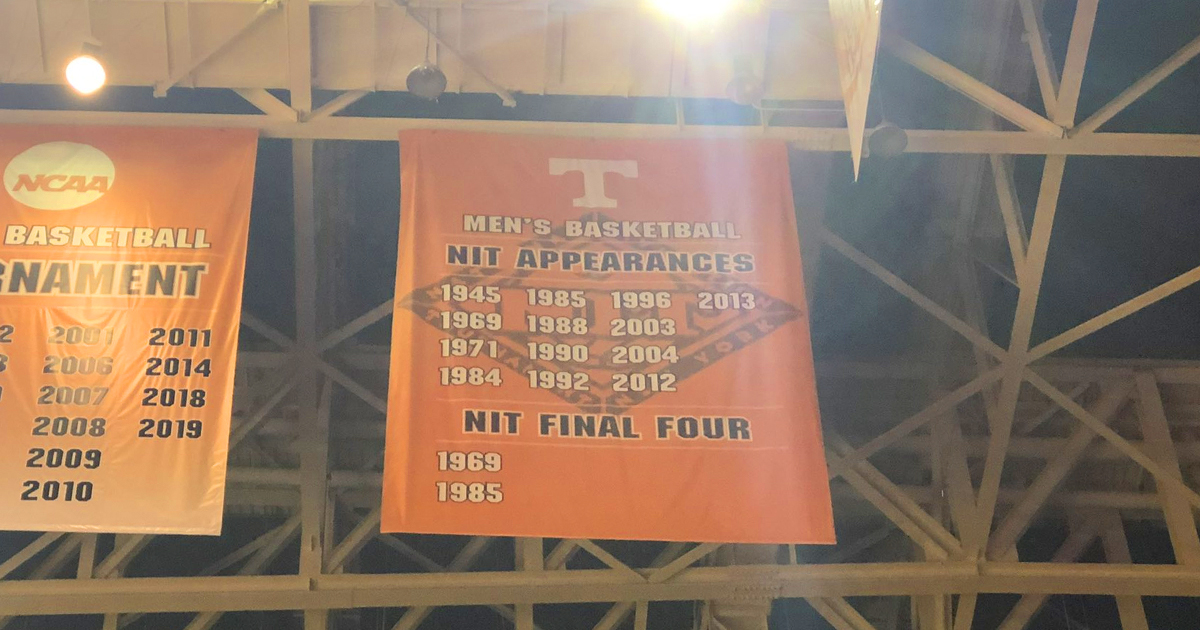
Unfortunately, due to multiple factors, the NIT is a tournament whose prominence has fallen drastically over the past few seasons. One reason why is that in 2023, the tournament’s final four was moved out of the historically prominent Madison Square Garden. This has taken a great deal of luster from this event, as the NIT’s final four was held there every year from 1938 to 2022. Another reason for the NIT’s downfall has been the emergence of a competitor tournament, the College Basketball Crown that contractually obligates the best non-NCAA tourney teams from the Big East, Big 12, and Big Ten to play in it, in lieu of the NIT. While this was a savvy business move by FOX Sports to prevent its main competitor, ESPN, from monopolizing the second-tier of postseason college basketball, it has certainly lowered the stature that the NIT had in the sport. However, the biggest reason for the downfall of the NIT was its absurd move in 2024 to stop giving automatic bids to mid-major regular season champions who lost in their respective conference tournament and instead “attempt” to give auto bids to the best non-NCAA tournament teams in power conference leagues. This was a pure panic move by the NIT in an attempt to maximize profits that backfired immediately when the selection committee for the tournament soon realized that most of the teams that earned automatic bids under this new format were declining them. In fact, in the past three years there have been a total of 56 teams who have declined NIT bids. This is the equivalent of some douchey high school students taking over a school club that used to be open to everyone and instead making it “invite-only” only to realize that no one wanted to accept their invites. The bottom line here is that the NCAA should expand its tournament to give meaningful postseason basketball back to schools that are who no longer served by a deteriorating NIT.
(4) Constant Growth of Division 1 Membership
When the NCAA basketball tournament expanded to 64 teams in 1985, there were a grand total of 282 Division 1 institutions, so roughly 23% of D-1 members were given a bid to the tournament. This is in line with the NCAA’s overarching guideline that approximately 25% of its membership institutions be granted access to each sport’s postseason. Now, we have 360 teams in Division 1 college basketball and only 68 of these are given NCAA basketball tournament bids. That means only 18.9% of Division 1 institutions are currently granted access to the NCAA tournament. Worse yet, the membership ranks continue to grow, as every year more and more schools try to maximize athletic profits and re-classify into Division 1, especially given the fact the NCAA has now made this process faster than ever. All three of the major professional leagues in America, the MLB, NFL, and NBA, have expanded their membership ranks over the past 30 years and all have consequently expanded their postseason format. The MLB has moved from 4 to 8 to now 12 postseason teams since the early 90’s. The NFL added two additional wildcard teams a few years ago. And the NBA now has a play-in tournament that grants four additional teams access to the postseason. The bottom line is that it just makes sense that if you increase the size of a league you should also increase the access to that league’s postseason play.
What Shouldn’t be Part of Expansion:
Before I get into what my proposed plan for NCAA tournament expansion looks like, I want to first heed my warning that if expansion is done incorrectly, it will destroy the prominence of March Madness. We, as a sporting society, have become so accustomed to the basic framework of the NCAA tournament as it stands now, so any expansion efforts must adhere to this framework. This means a few things:
(1) No First Round Byes!
The biggest gripe I have had about the proposed 96 team NCAA tournament format we heard about in 2010 was that it included first round byes for the top 32 teams. The Thursday and Friday of the first round of the NCAA tournament are the two best days on the American sports calendar, and it is not even close. These two days which I have come to refer to as “Christmas” in which religious services are observed and presents are given out at our house are special in American society due to their unpredictability and excitement. If the top ⅓ of the field had byes in that round and didn’t on those days, then the magic of the first round would be lost and the tournament as a whole would lose a lot of luster. Therefore, any expansion proposal must involve all eligible teams playing in the first round.
(2) Increase/Modifying Seed Lines
I have thought a lot about this as well, and I firmly believe any modifications to the NCAA tournament’s seeding structure would harm the event as well. The first round seedings matchups such as 1 vs. 16, 8 vs. 9, and 5 vs. 12 have become so ingrained in our thought process over the past forty years that I think any alteration to them would be quite disruptive. We don’t need to start having 4 vs. 29 seed games and 5 vs. 28 seed matchups that convolute what we think of as great upsets. Therefore, any expansion proposal should include the original 1-16 seed lines that we have all grown accustomed to, which can be accomplished by simply adding more 16-team regions to the current bracket, like you will see in my proposal below.
3) Changing the Schedule of Games:
Any expansion efforts also should not modify the general scheduling of NCAA the tournament with first round games being played on a Thursday and Friday in mid-March, second ground games being played on the subsequent Saturday and Sunday, followed by two additional weekends of games. March Madness fits perfectly into the sporting calendar and does not need to become drawn out to overlap with the Masters in April. Also, if you try to move first round games to the Tuesday and Wednesday when the First Four is currently played, the tournament just won’t be the same. With that being said, obviously, if you increase the size of any tournament, you will have to add more games somewhere, but you will see in my proposal below that an additional round of the tournament can be added without disrupting the current March Madness scheduling format.
My 128 Team NCAA Tournament Proposal/Bracket:
Without further ado, I have come up with what I believe to be a fairly unique expansion model to create a 128 team NCAA tournament that does not modify the framework of the tournament but does make it more inclusive and I believe more exciting than its current iteration. This 128 team tournament model would do all of the following:
- Keep teams seeded 1-16
- Keep the same number of tourney sites
- Add afternoon basketball to weeks 2 and 3 of the tourney
- Increase number of games at each time slot during the first four rounds of the tourney
- Give two teams from every conference automatic bids
- Create 31 additional at-large bids (66 total) to accommodate quality college basketball teams throughout the country
Let’s now talk about how this can be done.
Selecting the Field:
The 128 team tournament field I am proposing features 62 automatic bids (two going to each Division 1 conference) and 66 at-large teams. As mentioned previously, both the regular season and tournament champion from each conference would be given automatic bids to the NCAA tournament. Obviously, there will always be some circumstances when the same team wins both the conference regular season and postseason in which case the regular season runner-up from that league would earn the second at-large berth Using 2026 as a model, here is a table of which 62 teams would earn automatic bids to this year’s tournament based on this criteria. The teams in green font below are the ones who earned auto bids under the current tournament format. The teams in blue font are ones who earned at-large bids to this year’s tournament but would receive automatic bids based on my proposed format. And the teams in pink are the ones who were not given invites to this year’s Dance but would under this 128 team model. Also, teams with an asterisk next to their names in the “regular season champ” column are schools who were not regular season conference champions but because that league’s tournament champ also won their regular season title, they would receive the second automatic bid for that conference by virtue of being the regular season runner-up.
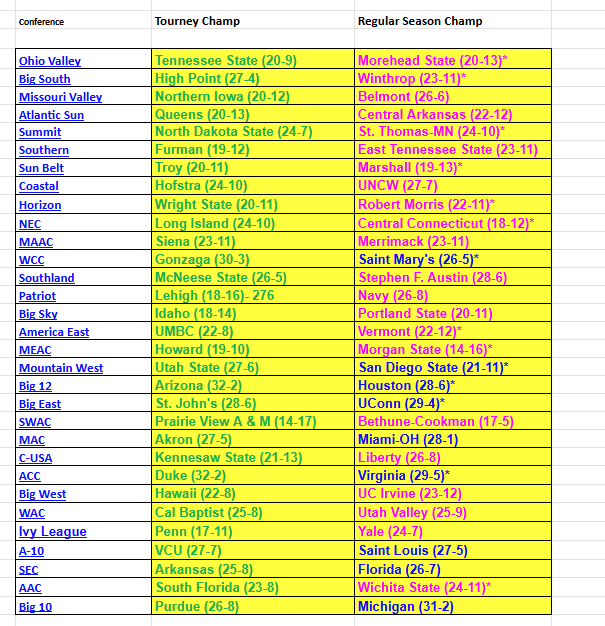
As you can see, this new format would allow for more mid-majors to enter the tournament which would also allow more upset opportunities and consequently more Cinderella stories to emerge. Now, the one complaint I am sure most people will have about this aspect of the proposal is that it would dampe the excitement of conference tournaments because they would no longer be “all or nothing” propositions. And while that point is valid, I would push back and say that the only games that would be made less significant in small conference tourneys are title games in which the # 1 and 2 seeds facing off against one another. In those contests, both teams would have clinched automatic bids based on my proposal, but in all other situations, the conference tournament final would still be determinative of who receives each league’s tournament championship bid to the Big Dance. This season, there were only seven confernce tourney finals featuring games between teams seeded # 1 and 2 in single bid leagues (Ohio Valley, Big South, America East, Big West, WAC, American, and Southland), so all other conference tourney finals would have been just as siginficant as they were this season.
The sixty-six at-large bids would then be awarded to the next best sixty-six teams, regardless of conference affiliation. Here is what that list would look like in order from the projected highest seeded at-large team to the lowest.
| At-Large Teams | |
| 1 | Iowa State (27-7) |
| 2 | Michigan State (25-7) |
| 3 | Illinois (24-8) |
| 4 | Nebraska (26-6) |
| 5 | Alabama (23-9) |
| 6 | Kansas (23-10) |
| 7 | Vanderbilt (26-7) |
| 8 | Texas Tech (22-10) |
| 9 | Wisconsin (23-10) |
| 10 | Tennessee (22-11) |
| 11 | North Carolina (24-8) |
| 12 | Louisville (23-10) |
| 13 | BYU (23-11) |
| 14 | Kentucky (21-13) |
| 15 | Miami-FL (25-8) |
| 16 | UCLA (23-11) |
| 17 | Clemson (24-10) |
| 18 | Villanova (24-8) |
| 19 | Ohio State (21-12) |
| 20 | Georgia (22-10) |
| 21 | TCU (22-11) |
| 22 | Iowa (21-12) |
| 23 | Santa Clara (25-8) |
| 24 | UCF (21-11) |
| 25 | Missouri (20-12) |
| 26 | Texas A & M (21-11) |
| 27 | NC State (20-13) |
| 28 | Texas (17-14) |
| 29 | SMU (20-13) |
| 30 | Auburn (17-16) |
| 31 | Indiana (18-14) |
| 32 | Oklahoma (19-15) |
| 33 | New Mexico (24-10) |
| 34 | Cincinnati (18-15) |
| 35 | Tulsa (26-7) |
| 36 | Seton Hall (21-12) |
| 37 | Virginia Tech (19-13) |
| 38 | West Virginia (18-14) |
| 39 | Boise State (19-11) |
| 40 | Stanford (20-12) |
| 41 | Florida State (18-15) |
| 42 | Wake Forest (18-17) |
| 43 | California (21-12) |
| 44 | Dayton (25-11) |
| 45 | Nevada (24-12) |
| 46 | Arizona State (17-16) |
| 47 | Oklahoma State (20-15) |
| 48 | Colorado (17-15) |
| 49 | Southern Cal (17-14) |
| 50 | Baylor (15-16) |
| 51 | Washington (16-17) |
| 52 | Northwestern (15-19) |
| 53 | Grand Canyon (20-12) |
| 54 | LSU (15-17) |
| 55 | Providence (15-18) |
| 56 | Minnesota (15-17) |
| 57 | Creighton (15-17) |
| 58 | Butler (16-16) |
| 59 | Syracuse (15-17) |
| 60 | Colorado State (20-13) |
| 61 | Georgetown (16-18) |
| 62 | George Washington (18-16) |
| 63 | George Mason (22-10) |
| 64 | Illinois State (21-12) |
| 65 | Xavier (15-18) |
| 66 | Ole Miss (15-20) |
Please note that the top 29 teams on the list below already earned at-large bids to this year’s tourney under the current 68 team format, while teams ranked 30-68 would be at-large teams added under the new format. I must admit that I have a little personal bias here, as my Wake Forest Demon Deacons would have made the NCAA tourney under this 128 team format in each of the past five tournaments, whereas they have instead fallen short of the Big Dance in each of those seasons. With that being said, the depth of college basketball is unquestionably better than it has been given the number of 4, 5, 6 and sometimes even 7 year players playing the game. As a result, it only makes sense to increase the size of the NCAA tournament at-large field to accommodate this depth of talent.
Seeding the Teams:
Now that we have our 128 team field under this new format, let’s talk about how we are going to seed them and divide them up into regions. Like I said earlier, it is imperative that we keep the same 1-16 seeding format that we have grown accustomed to and the only way to do that and while expanding the field is to add regions. We are, in fact, going to double the number of regions from four to eight. The regional names will be geographically symmetric in that we will have an East, Northeast, Mideast, and Southeast regional, as well a West, Northwest, Midwest, and Southwest regional. And since we will now have eight different regions seeded 1-16, we are going to have eight teams featured on each seed line. As a result, the top eight teams in the country will be # 1 seed, the next eight will be 2 seeds, etc. For example, all of the 1 and 2 seeds in this year’s tournament will be # 1 seeds under this new bracket format.
Site Locations:
Since there are now eight different regions featuring 16 teams, we will have twice as many games in each round under this new format. However, we will not need to add NCAA tournament sites under my proposal for any portion of the tournament. Instead, we will just double the number of games at each site, which would be surprisingly easy to do. As you all know, during the first weekend of the tournament there are four different Thursday-Saturday first and second round NCAA tourney sites and four different Friday-Sunday first and second round sites. During the second weekend of March Madness, there are two different Thursday-Saturday Sweet 16 and Elite 8 sites and two different Friday-Saturday Sweet 16 and Elite 8 sites. In my proposal, we are going to make each of these sites Thursday-Sunday locations that host games each day instead of taking days off. Therefore, during the first weekend of the tournament each designated site location will host four different pods, instead of the usual two. For instance, under this new format, the city of St. Louis would have hosted two first round games on Thursday afternoon this year, two on Thursday evening, two on Friday afternoon, and two on Friday evening instead of just hosting two Friday sessions as they did under the current format. Similarly, during the second weekend of the tournament each of the four designated sites would host two sets of regional semifinals (one on Thursday and one on Friday) instead of the one set they currently host. This is similar to how the NCAA women’s tournament currently handles its second weekend site locations. This would be extremely beneficial because the NCAA wouldn’t have to spend additional money to rent out additional venues since they are already renting out all of these tourney sites from Thursday-Sunday anyway. This would also make the act of hosting a NCAA tournament site more valuable in that you would have twice as many teams and their respective fans coming to your city as they do currently (16 teams would be at each first and second round site instead of the current 8 and 8 teams would be at each third and fourth round site instead of the current 4).
The Bracket:
Now, let’s get to what this year’s NCAA tournament bracket would look like using this format. It should be noted that I used the exact same seedings and rankings for each team as this year’s selection committee, and I bracketed the teams as closely as possible to how they were in year’s tournament. Please click on the screenshot of each half of the bracket to enlarge it.
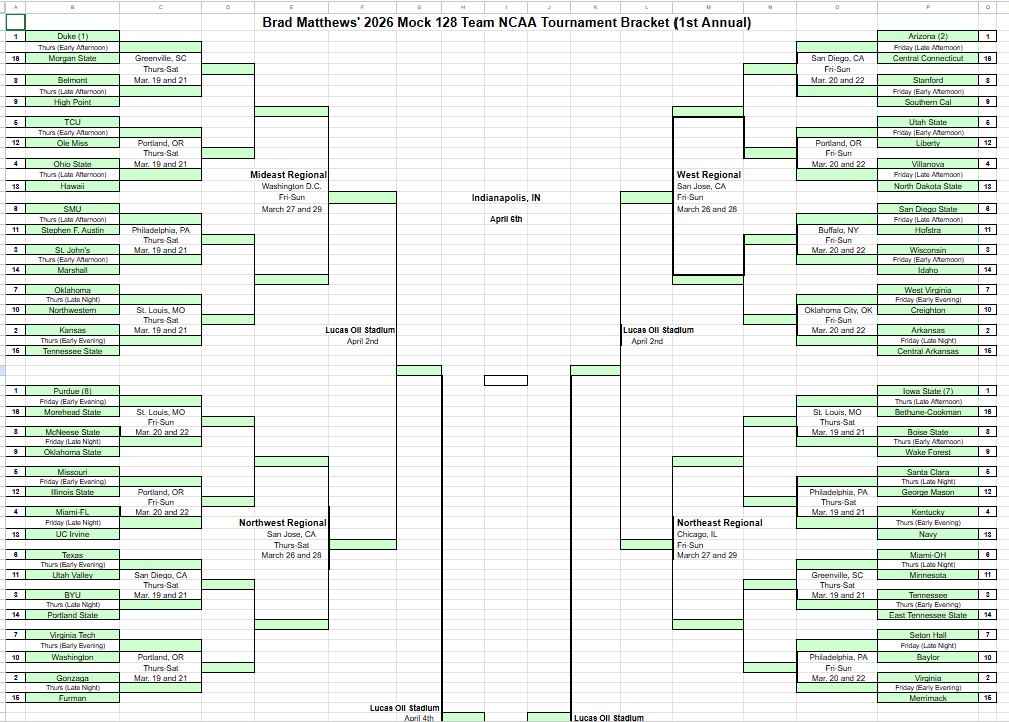
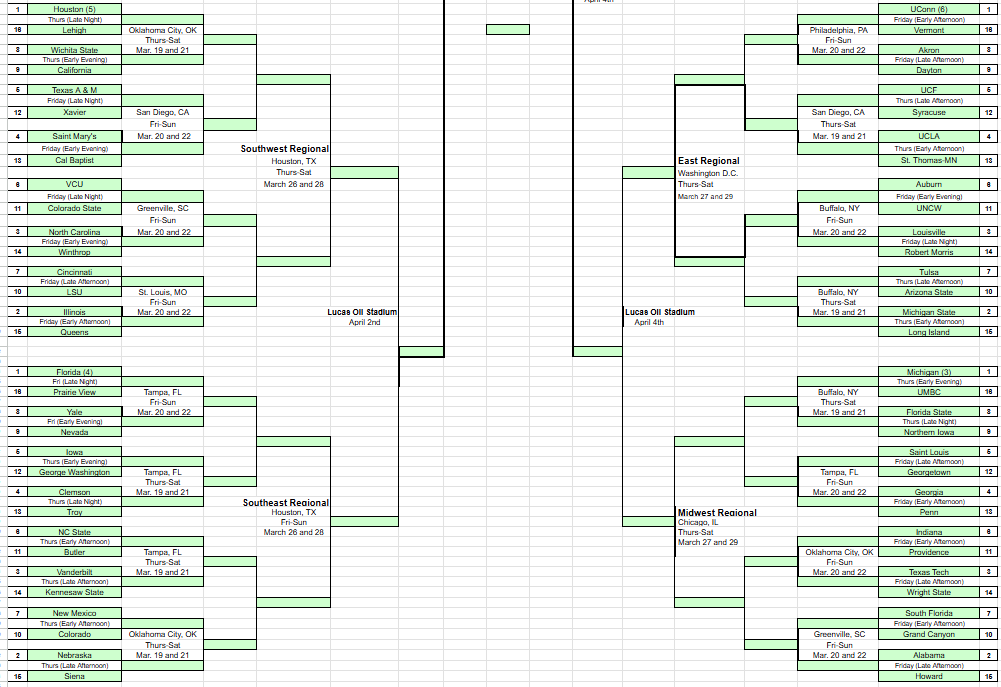
One thing you will notice about this bracket is that we no longer have to worry about having teams from the same conference play in the second or third round of the tournament. Traditionally, teams from the same conference couldn’t play one another until the Elite 8, but around a decade ago, that bracket principle was relaxed to allow for teams from the same conference to play one another as early as the second round if they had only met once during the regular season. That is how we ended up with Sweet 16 games like Iowa/Illinois this past year and Kentucky/Tennessee last year. And while there is nothing inherently wrong about playing a conference game rematch during the NCAA tournament, this is a national event that should involve new and fresh matchups between teams from all across the country. The 128 team bracket accomplishes this because now instead of just having eight “half regions” to place teams from the same conference in, we have sixteen of these “half regions” which is more than enough to accommodate even the largest of conferences. Thus, the earliest two teams from the same conference can play one another in this proposal would be the Regional Finals (aka the Fourth Round).
The Schedule:
As you see above, for the first two weekends of the tournament, my proposal calls for the same number of rounds as we currently have with just twice as many games played on each day. This obviously begs the question where does the extra round come into play because an expanded 128 team NCAA tourney has to have seven rounds instead of six? The answer is that this proposal calls for the eight regional champions to play one another on the third Thursday of the tournament in the Elite 8 which will be held at the same location as the Final Four. Thus, we are simply converting the last weekend of the tourney into Elite 8 weekend with four games on Thursday, two on Saturday, and one Monday instead of the current Final Four weekend where there are only games on Saturday and one on Monday. This would resolve one of my biggest complaints of the current tourney format and that is that Final Four weekend gets a ton of hype but is essentially too short. Now, we would have four additional games being played that weekend on a third day. This would slightly change the nomenclature of the rounds as the Regional Finals would no longer be the Elite 8. Instead, the rounds would be referred to as : the First Round (or Round of 128), the Second Round (or Round of 64), the Regional Semifinals (or Third Round or Round of 32), the Regional Finals (or Fourth Round or Sweet 16), the Elite 8 (or the National Quarterfinals), the Final Four (or National Semifinals), and of course the National Championship Game. And when you break down the schedules for each of these rounds, here is how each day of the tourney would look on a day-by-day basis.
First Round (first Thursday and Friday): Eight different games will be played in each time slot at all eight different site locations on both days under my proposal. This would allow for each time slot to have every type of NCAA tourney game (1/16, 2/15 3/14, 4/13, 5/12, 6/11, 7/10, and 8/9) going on at the same time, which has to get you excited. No more “dull” time slots where you have a 2-3 blow out 1 vs. 16 and 2 vs. 15 games and maybe one semi-close 7 vs. 10 contents. Instead, with eight games going on at once all over the bracket, you are guaranteed to have some drama. Here is what that would look like based on the 128 team bracket I created for this year’s tournament.
| Thursday (Early Afternoon) | Thursday (Late Afternoon) | Thursday (Early Evening) | Thursday (Late Night) | |
| Buffalo | (2) Michigan State vs. (15) Long Island | (7) Tulsa vs. (10) Arizona State | (1) Michigan vs. (16) UMBC | (8) Florida State vs. (9) Northern Iowa |
| Greenville | (1) Duke vs. (16) Morgan State | (8) Belmont vs. (9) High Point | (3) Tennessee vs. (14) East Tennessee State | (6) Miami-OH vs. (11) Minnesota |
| Oklahoma City | (7) New Mexico vs. (10) Colorado | (2) Nebraska vs. (15) Siena | (8) Wichita State vs. (9) California | (1) Houston vs. (16) Lehigh |
| Portland | (5) TCU vs. (12) Ole Miss | (4) Ohio State vs. (13) Hawaii | (7) Virginia Tech vs. (10) Washington | (2) Gonzaga vs. (15) Furman |
| Tampa | (6) NC State vs. (11) Butler | (3) Vanderbilt vs. (14) Kennesaw State | (5) Iowa vs. (12) George Washington | (4) Clemson vs. (13) Troy |
| Philadelphia | (3) St. John’s vs. (14) Marshall | (6) SMU vs. (11) Stephen F. Austin | (4) Kentucky vs. (13) Navy | (5) Santa Clara vs. (12) George Mason |
| San Diego | (4) UCLA vs. (13) St. Thomas-MN | (5) UCF vs. (12) Syracuse | (6) Texas vs. (11) Utah Valley | (3) BYU vs. (14) Portland State |
| St. Louis | (8) Boise State vs. (9) Wake Forest | (1) Iowa State vs. (16) Bethune-Cooklman | (2) Kansas vs. (15) Tennessee State | (7) Oklahoma vs. (10) Northwestern |
| Friday (Early Afternoon) | Friday (Late Afternoon) | Friday (Early Evening) | Friday (Late Night) | |
| Buffalo | (3) Wisconsin vs. (14) Idaho | (6) San Diego State vs. (11) Hofstra | (6) Auburn vs. (11) UNCW | (3) Louisville vs. (14) Robert Morris |
| Greenville | (7) South Florida vs (10) Grand Canyon | (2) Alabama vs. (15) Howard | (3) North Carolina vs. (14) Winthrop | (6) VCU vs. (11) Colorado State |
| Oklahoma City | (6) Indiana vs. (11) Providence | (3) Texas Tech vs. (14) Wright State | (7) West Virginia vs. (10) Creighton | (2) Arkansas vs. (15) Central Arkansas |
| Portland | (5) Utah State vs. (12) Liberty | (4) Villanova vs. (13) North Dakota State | (5) Missouri vs. (12) Illinois State | (4) Miami-FL vs. (13) UC Irvine |
| Tampa | (4) Georgia vs. (13) Penn | (5) Saint Louis vs. (12) Georgetown | (8) Yale vs. (9) Nevada | (1) Florida vs. (16) Prairie View A & M |
| Philadelphia | (1) UConn vs. (16) Vermont | (8) Akron vs. (9) Dayton | (2) Virginia vs. (15) Merrimack | (7) Seton Hall vs. (10) Baylor |
| San Diego | (8) Stanford vs. (9) Southern Cal | (1) Arizona vs. (16) Central Connecticut | (4) Saint Mary’s vs. (13) Cal Baptist | (5) Texas A & M vs. (12) Xavier |
| St. Louis | (2) Illinois vs. (15) Queens | (7) Cincinnati vs. (10) LSU | (1) Purdue vs. (16) Morehead State | (8) McNeese State vs. (9) Oklahoma State |
Now, that’s quite the slate folks! Yes, I realize that TV contracts would have to be re-negotiated to allow for eight televised games at once but with all of the networks and/or streaming services that would love to cash-in on March Madness, this shouldn’t be a problem.
Second Round: The second round of the NCAA tournament would essentially become the first round in terms of the number of teams involved, the number of games, and the potential matchups (see Ohio State/TCU, Texas/BYU, Saint Mary’s/Texas A & M, etc. in the bracket above). Sixteen games would be played on both Saturday and Sunday and we could go back to having multiple games on during the day during the first weekend of the NCAA tournament. I really don’t like the move that was made about twenty years ago to only televise one game in each daytime session on both the first Saturday and Sunday of the tournament and then stagger the rest of the games throughout each of those evenings. Instead, in my proposal, we would have four games at each time slot throughout the day and night on both Saturday and Sunday of the first weekend.
Regional Semifinals: One other neat aspect of the scheduling of games within my proposal is that we would have more daytime basketball during the week! As described above, each of the four locales set aside for second weekend games would host two different sets of regional semifinals. For instance, this season Houston would have hosted one set of regional semifinal games on Thursday (Southwest Regional) and another set on Friday (Southeast Regional) instead of having just the one set of Thursday games. I think the start times for this round could ultimately be set up like the current second round with one featured game at each time slot on both Thursday and Friday afternoons and then six additional games scattered throughout the evening each night.
Regional Finals: There would be sixteen teams remaining by the time the Regional Finals weekend rolled around as a result we could have one game at each of the four time slots on each day. For instance, Washington DC could play its two regional finals in the early afternoon on both Saturday and Sunday, Houston could play its two regional finals in the late afternoon those days, Chicago could play theirs in the early evening, and San Jose could be the late night slot on both nights. Also, like I discussed above in relation to the first weekend NCAA tournament sites, the value of hosting a second weekend NCAA tourney site would be enhanced because of the fact eight different teams would be playing in each city, as opposed to the current four.
Elite Eight: This is that extra round of the tournament that I discussed above, which I think would be a whole lot of fun. Once all the regional champions were determined, all eight of these teams would come together and play a round of quarterfinal games in one arena (the same site as the Final Four and Championship Game) on the third Thursday of the tournament. This would mean we would now have afternoon NCAA tournament basketball for a third straight Thursday in March! Two of the quarterfinal games would be played on Thursday afternoon and two would be played on Thursday evening. Also keep in mind, that no teams would ever have to play on back-to-back days in this 128 team format as every team that advanced to the final would play on either Thursday-Saturday or Friday-Sunday during the first two weekends of the tournament (like they do currently) and then play their final three rounds of games on the Thursday, Saturday, and Monday of the tourney’s final weekend.
Final Four/Championship Game: These rounds would function the exact same way they do currently with the two national semifinals being played on the evening of the third Saturday of the tournament and the national title game being played on the following Monday. No reason to mess with a good thing here.
We could also get rid of the First Four altogether as we no longer would need to have four play-in games to make the field more inclusive. Dayton is a great location for college basketball games so now it can be used as a rotational first and second round site instead of the permanent home of the least meaningful four games of the tournament.
So there it is folks, my argument and proposal for a 128 team NCAA tournament! Don’t get me wrong, the 64 team bracket is still great. However, if this expanded NCAA tourney model came into fruition, I strongly believe March Madness would become even better!
 Ramblings of the Ultimate Sports Sentimentalist